Commercial Water Line Installation
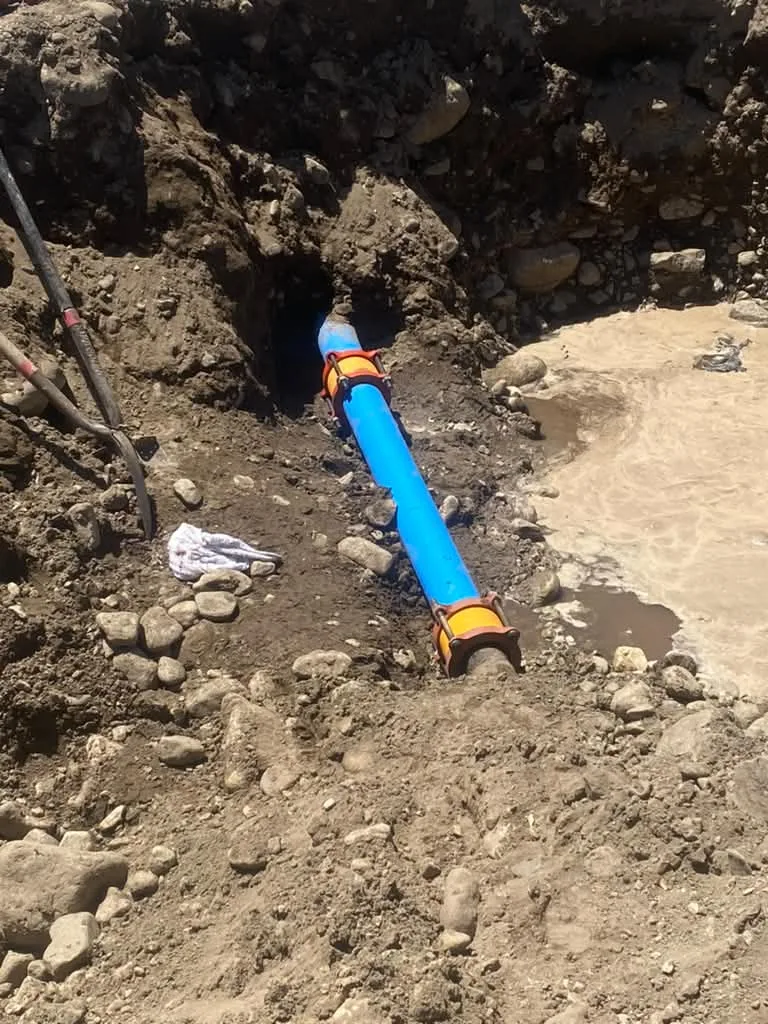
A new commercial water service has to be sized for the building's real demand, including fire protection where it applies, and coordinated with the utility and the inspection process.
A new commercial water service has to be sized for the building's real demand, including fire protection where it applies, and coordinated with the utility and the inspection process.
When to call
The older tracts and the newer ones fail in different ways, and knowing which you are standing in is most of a fast diagnosis.
These are the symptoms that usually prompt the call. Any one of them is worth a conversation, and most of them get cheaper to deal with the earlier they are looked at.
A new commercial build
A building changing use or expanding
An undersized existing service
Adding a fire service connection
Replacing a service line at end of life
Ignoring an early symptom does not save money. It moves the spending to a worse moment and adds restoration work to it.
Electronic leak detection lets us narrow a slab leak to a spot rather than a room.
Size for actual demand
Fixture count, peak demand and any fire protection requirement.
Coordinate with the utility
Connection, meter and the utility's own requirements and timelines.
Install to code with backflow protection
Commercial services generally require backflow prevention, which we install and test.
Test, inspect and commission
Pressure tested, inspected, documented.
We separate what needs doing now from what is worth planning for, because those are different conversations and different budgets.
Utility coordination, not installation, normally drives the schedule on a new commercial service. Connection scheduling, meter provision and the purveyor's own requirements and lead times sit outside our control, and they are the long pole. We start that process early and keep you informed, because a building waiting on a meter is an expensive kind of waiting.
Locating equipment marks depth and position before anyone digs, which is the difference between one careful excavation and several exploratory ones.
Four decades of work in this region built a service area that covers most of the Inland Empire. If you are outside the usual radius, call and ask. We cover more ground than most shops our size.
Electronic leak detection lets us narrow a slab leak to a spot rather than a room.
Ignoring an early symptom does not save money. It moves the spending to a worse moment and adds restoration work to it.
Exercise your shutoff valves once a year. A quarter turn and back keeps them from seizing, and a main shutoff that will not turn during an emergency is a much more expensive problem than one that gets used occasionally.
The cheapest plumbing is the kind that gets looked at before it fails. An annual walk of the visible plumbing, checking under sinks, around the water heater and at any exposed pipe, catches most problems while they are still small and dry.
Keep grease out of drains, and that includes running hot water after it. Hot water simply carries it further down the line to somewhere less convenient.
Knowing your own system is worth real money. Where the main shutoff is, where the sewer cleanout is, how old the water heater is, and whether the property is on sewer or septic. Those four facts shorten every future service call you will ever have.
Scheduling is straightforward: call, describe what is happening, and we will give you a real window rather than a vague promise.
A lot of our work comes from customers we have had for decades, and from the people they send us. That is essentially the whole marketing strategy and it has held up for forty-four years.
We are licensed across plumbing, sanitation and general engineering, which reflects the range of work this region actually needs.
If the honest answer is that you do not need the bigger job yet, that is the answer you will get.
Big Mike's · Yucaipa, California
If yours is not here, call and ask. We would rather talk it through than have you guess.
By fixture count and peak demand, plus fire protection requirements where they apply. Undersizing shows up as pressure problems at the worst time.
Almost always on a commercial connection. The water purveyor sets the requirement and the assembly must be tested.
Yes, that coordination is a significant part of the work and the timeline.
Utility coordination usually drives the schedule more than the installation does.
Yes. We hold plumbing, sanitation and general engineering contractor licensing, which lets one shop handle work that runs from inside the house out to the septic field.
Yes. We haul off whatever we replaced and put the area back. You should not be able to tell we were there except that it works.
Yes. Residential, commercial and industrial, including offices, apartment complexes, hotels, restaurants and plant systems.
Know where your main water shutoff is and whether it turns. Clear access to the work area. If you smell gas, leave the building and call from outside.
Commercial plumbing is judged on continuity rather than on the repair itself. A fault that closes a kitchen, empties an office or takes rooms out of service costs far more in lost operation than in plumbing labor. That changes the right answer to a lot of questions: whether to schedule work overnight, whether to build in redundancy, and whether a maintenance interval is worth paying for.
Knowing when the problem started, whether it is constant or intermittent, and whether anything was done to the property recently tells us a surprising amount before we arrive.
The region we cover takes in older established towns and newer developments alike, which is useful, because working across both keeps us fluent in what each one does.
Locating leaks in commercial structures.
Keeping business drains running.
Failed commercial water services.
Supplying and installing fixtures.
Multifamily plumbing across many units.
Protecting potable supply from cross-connection.
Tell us what it is doing and we will tell you what it takes to fix it. Plain language, no sales pitch, and the number before we start.
Yucaipa, California · Serving San Bernardino, Riverside and eastern Los Angeles counties · Open 24 hours