Repiping
Repiping replaces the supply piping through a building rather than repairing it section by section. It is the right answer when the pipe itself has reached the end of its life and the leaks have started arriving in a pattern.
Repiping replaces the supply piping through a building rather than repairing it section by section. It is the right answer when the pipe itself has reached the end of its life and the leaks have started arriving in a pattern.
When to call
Much of what we replace was installed correctly, to the code of its day, and has simply reached the end of a long life.
These are the symptoms that usually prompt the call. Any one of them is worth a conversation, and most of them get cheaper to deal with the earlier they are looked at.
Several leaks in a short span of time
Brown or rusty water from the taps
Pressure that drops when another fixture runs
Visible corrosion at exposed pipe and fittings
Galvanized supply piping of any age
The damage around a leak is usually more expensive than the leak, which is why we push people to have things looked at early.
Electronic leak detection lets us narrow a slab leak to a spot rather than a room.
Establish that the pipe is the problem
One leak is a repair. A sequence of leaks in the same material is the system telling you something.
Plan the routes
Where the new lines run, where access is needed, and how much of the building is affected at any one time.
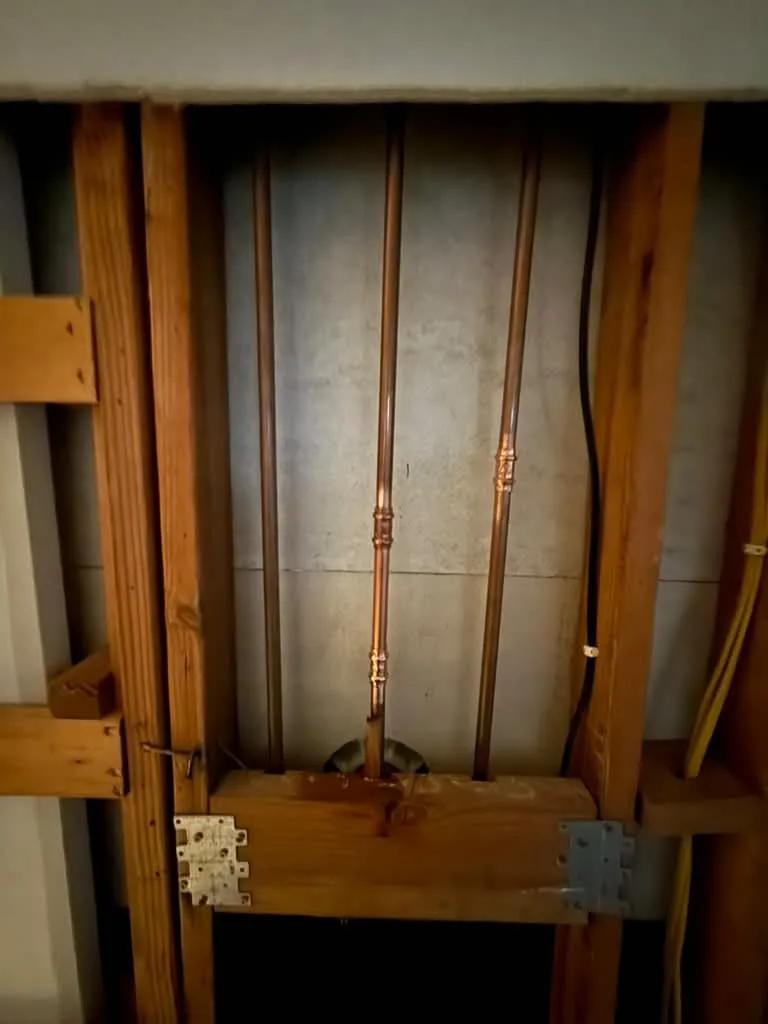
Run the new system
Copper or PEX depending on the building, the budget and what makes sense. We will explain the trade-offs rather than just picking for you.
Restore and test
Access points closed up, pressure tested, and every fixture checked.
You will know the cost before the work starts. Surprises on an invoice are how contractors lose customers permanently.
The question people ask is how they know it is time, and the honest answer is that the pipe tells you in a pattern. One leak is an event. Two leaks in different places within a year or two, in the same material, is the material failing rather than bad luck. Galvanized supply is a slightly different case: it closes up from the inside regardless of whether it has leaked yet, and by the time you have brown water and falling pressure the pipe has been deteriorating for a long time.
Our trucks carry waterproof high-definition camera equipment, locating gear, cable machines and jetting capability, which means most calls are diagnosed and resolved on the same visit rather than turning into a sequence of appointments.
Our coverage reaches from the mountain-adjacent communities down through the valley floor and out to the desert cities. If you are outside the usual radius, call and ask. We cover more ground than most shops our size.
Electronic leak detection lets us narrow a slab leak to a spot rather than a room.
The damage around a leak is usually more expensive than the leak, which is why we push people to have things looked at early.
Check the pressure at a hose bib occasionally. Above about eighty psi you are shortening the life of every fixture, valve and appliance in the building, and a regulator is a cheap fix.
If you have had a line cleared more than once, ask for a camera inspection rather than a third clearing. Repeated blockages nearly always have a physical cause worth finding.
Water heaters benefit from an annual flush in this region more than almost anywhere else, because our water leaves sediment on the bottom of the tank where the heat has to pass through it.
Look behind and under appliances once in a while. Washing machine hoses, dishwasher connections and ice-maker lines are common leak sources and they are all hidden from normal view.
For commercial and industrial customers we schedule around operating hours as a matter of course.
Big Mike started with a truck and a phone number in 1982. The phone number has not changed and neither has the standard he set, because the people running it now learned the trade from him.
Properties on septic frequently need plumbing, sanitation and excavation work on the same job. Holding all three classifications means that is one crew and one schedule.
We will tell you what is wrong, what it takes to fix, and what happens if you wait. Then it is your call.
Big Mike's · Yucaipa, California
If yours is not here, call and ask. We would rather talk it through than have you guess.
Both are good. Copper is rigid, long-proven and takes heat. PEX is flexible, needs fewer joints and handles hard water well. The building and the layout usually point to one.
Most houses are a matter of days rather than weeks. We plan it so you are not without water overnight.
Some access is needed, but far less than people expect. We plan routes to minimize it and we close up what we open.
Galvanized supply is on borrowed time regardless of how it looks. With copper, repeated pinhole leaks mean the material is failing rather than unlucky.
Yes. The line is answered live around the clock, so you are talking to somebody who can send a truck, not leaving a message for the morning.
Yes, and it is usually worth doing. A second issue looked at during a visit you are already paying for costs far less than a separate call.
Where the work requires them, yes. Permits and inspections are handled as part of the job rather than left to the customer.
For simple, well-defined jobs sometimes. For anything that needs diagnosis, a number quoted blind is a guess, and we would rather look first and give you a real figure.
Water pressure is worth understanding because too much of it quietly destroys a house. Above about eighty psi, fixtures wear faster, appliance valves fail early and pipe joints take stress they were not designed for. A great many homes in this region run higher than they should because the supply pressure in the street is high and nobody has ever checked the regulator.
If you have used chemical drain products, tell us. It changes how we open the line and it matters for the technician's safety.
We reach the valley cities routinely and the outlying communities regularly. If you are unsure whether you are in range, the answer is usually yes and it costs nothing to ask.
Full lateral replacement when repair is past the point.
Slow and stopped drains, cabled and cleared.
No hot water, leaking tanks, failed elements.
Hard-water treatment for Inland Empire supply.
Residential boiler and hydronic faults.
New gas runs for appliances and outdoor kitchens.
We run repiping out of Yucaipa across Diamond Bar, West Covina, San Dimas, Rancho Mirage, Covina, Pomona and Jurupa Valley, and the rest of San Bernardino, Riverside and the eastern edge of Los Angeles County.
Tell us what it is doing and we will tell you what it takes to fix it. Plain language, no sales pitch, and the number before we start.
Yucaipa, California · Serving San Bernardino, Riverside and eastern Los Angeles counties · Open 24 hours