Industrial Water Systems
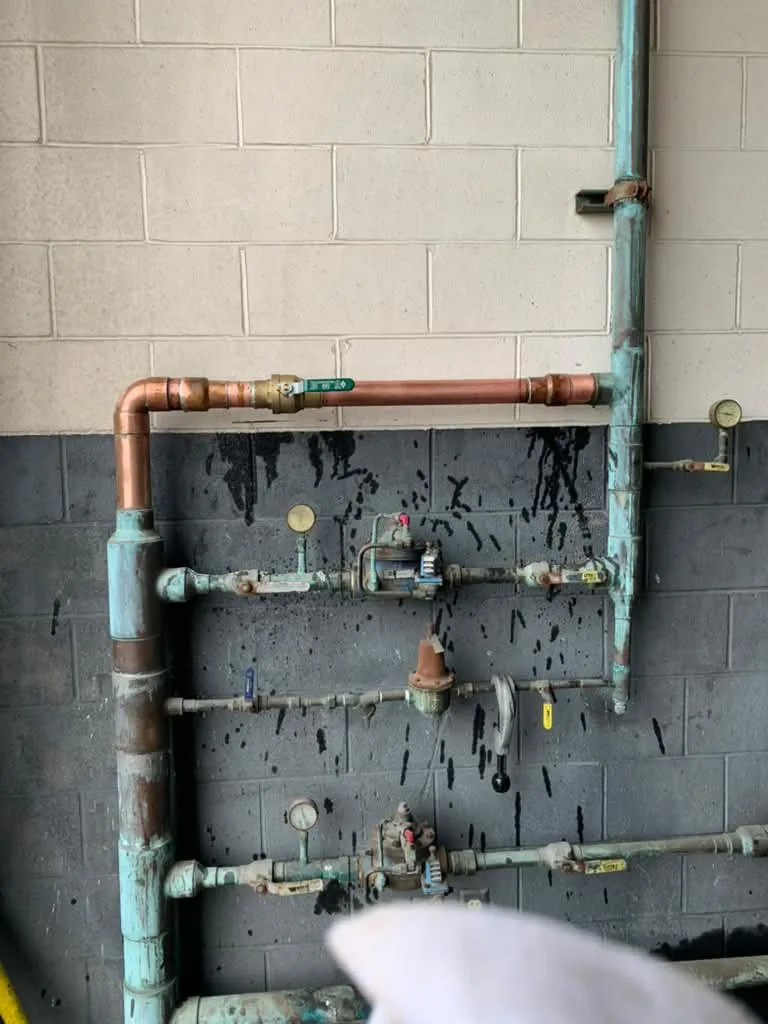
Industrial water is a process input. Failures stop production, so the work is about reliability, correct sizing and knowing the consequences of downtime before it happens.
Industrial water is a process input. Failures stop production, so the work is about reliability, correct sizing and knowing the consequences of downtime before it happens.
When to call
A lot of the housing out here went up between the 1950s and the 1970s, which means cast-iron sewer laterals and galvanized supply lines that are well past their design life.
These are the symptoms that usually prompt the call. Any one of them is worth a conversation, and most of them get cheaper to deal with the earlier they are looked at.
Process water supply problems
Pressure or flow inadequate for equipment
Aging industrial supply piping
Expansion requiring additional capacity
Water quality affecting process or equipment
Left alone, most of these problems take something else with them: a floor, a cabinet, a section of drywall, sometimes a foundation.
We trace the problem back to its source rather than treating whatever symptom brought us out.
Understand the process requirement
Flow, pressure and quality requirements come from the equipment, not a rule of thumb.
Assess the existing system
Capacity, condition and where the constraints actually are.
Plan around production
Shutdown windows are usually the binding constraint on the whole job.
Install, test and document
Proven under real operating conditions.
The number you approve is the work we do. If something changes once we are into it, we stop and talk to you first.
For a plant, plumbing work is planned around the shutdown window and that constraint shapes everything else. Materials staged in advance, sequence worked out beforehand, and wherever practical new runs built alongside the old ones so the cutover itself is short. Downtime is the expensive part, not the labor.
Diagnostic gear earns its keep by ruling things out. Most of the value is in the repairs you do not end up paying for.
Four decades of work in this region built a service area that covers most of the Inland Empire. If you are outside the usual radius, call and ask. We cover more ground than most shops our size.
We trace the problem back to its source rather than treating whatever symptom brought us out.
Left alone, most of these problems take something else with them: a floor, a cabinet, a section of drywall, sometimes a foundation.
Water heaters benefit from an annual flush in this region more than almost anywhere else, because our water leaves sediment on the bottom of the tank where the heat has to pass through it.
Check the pressure at a hose bib occasionally. Above about eighty psi you are shortening the life of every fixture, valve and appliance in the building, and a regulator is a cheap fix.
Watch your water bill. A bill that climbs without a change in habits is often the only warning a hidden leak will give you before the damage shows.
Look behind and under appliances once in a while. Washing machine hoses, dishwasher connections and ice-maker lines are common leak sources and they are all hidden from normal view.
Urgent calls get triaged on the phone. Sometimes the most valuable thing we do is tell you what to do in the next two minutes.
This company has been in one family since 1982, through three generations of Inland Empire housing and every change in the trade along the way.
Properties on septic frequently need plumbing, sanitation and excavation work on the same job. Holding all three classifications means that is one crew and one schedule.
Big Mike started this shop in 1982 and handed it to his kids because he trusted them to run it the same way. That is still who answers the phone.
Big Mike's · Yucaipa, California
If yours is not here, call and ask. We would rather talk it through than have you guess.
Yes. Shutdown windows drive industrial work and we plan to them.
Yes, including the separation and backflow protection between them that the code requires.
Planning, staging materials in advance, and where practical building new runs before cutting over.
Yes, around the clock. For a plant, response time is usually the whole question.
For simple, well-defined jobs sometimes. For anything that needs diagnosis, a number quoted blind is a guess, and we would rather look first and give you a real figure.
Regularly. We coordinate around construction schedules, tenant access and operating hours as a matter of course.
If it is actively causing damage or has made the property unusable, treat it as one and call. Water through a ceiling, sewage backing up and any gas smell all qualify.
No. Quotes are free and they come after we have looked at the actual problem, not over the phone from a description.
Coordination with a plant's own maintenance team is usually how industrial work goes best. They know the process, the schedule and the equipment; we know the plumbing. The jobs that go badly are the ones where a contractor works in isolation from the people who understand what the system is actually doing.
Photographs of the problem, particularly if it is intermittent and might not be happening when we arrive, are genuinely useful.
Forty-four years of work in one region builds a footprint that covers a lot of towns, and the trucks are on the road across it every day.
Plant failures that stop production.
Heavy jetting for industrial lines.
Industrial drainage and waste lines.
Pressurized lines failing under a concrete slab.
Slow and stopped drains, cabled and cleared.
Point-of-entry and whole-house filtration.
We run industrial water systems out of Yucaipa across Palm Desert, Canyon Lake, Indian Wells, Redlands, Walnut, Wildomar and Claremont, and the rest of San Bernardino, Riverside and the eastern edge of Los Angeles County.
Tell us what it is doing and we will tell you what it takes to fix it. Plain language, no sales pitch, and the number before we start.
Yucaipa, California · Serving San Bernardino, Riverside and eastern Los Angeles counties · Open 24 hours