Leach Line Installation
New leach lines are what a property needs when the field is done rather than blocked. The tank can be sound and the lines still finished, because a field fails by the soil around it sealing up, not by the pipe wearing out.
New leach lines are what a property needs when the field is done rather than blocked. The tank can be sound and the lines still finished, because a field fails by the soil around it sealing up, not by the pipe wearing out.
When to call
Root intrusion is relentless here. Mature landscaping and old clay or cast-iron joints are a bad combination that shows up as a backup every few months.
These are the symptoms that usually prompt the call. Any one of them is worth a conversation, and most of them get cheaper to deal with the earlier they are looked at.
A field that keeps surfacing after every attempt to clear it
Sewage odor and soggy ground over the lines
Backups that return within days of a pump-out
A system that predates any record of the field being replaced
Adding bedrooms or fixtures beyond what the field was sized for
A problem caught at the first symptom is a repair. The same problem six months later is often a replacement.
An accurate diagnosis is the whole foundation of a repair that actually lasts.
Test the soil and size the field
Percolation governs how much field the parcel needs. Guessing this is how a new field fails early.
Permit the work
Both counties permit drain field installation and inspect it before cover.
Find ground that will work
A replacement field often cannot go where the old one is. Setbacks from wells, property lines and structures narrow the options quickly.
Trench, bed and lay the lines
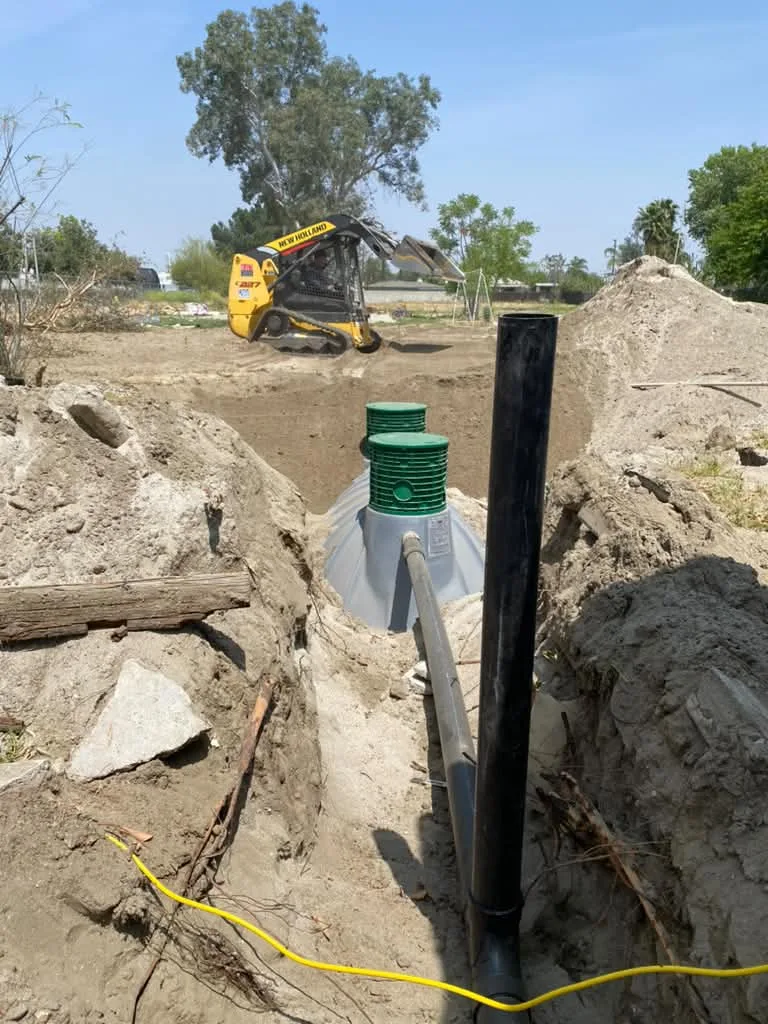
Gravel bed, perforated line at the right fall, distribution box set level so every line takes its share.
Inspect, cover and restore
Signed off before backfill, then the surface put back.
Being straight about scope is why most of our work comes from repeat customers and people they sent us.
A replacement field is often limited less by the budget than by the parcel. Setbacks from the well, the property line, the structure and any watercourse all apply, and on the smaller lots around here that can leave surprisingly little ground to work with. That is the first thing we establish, because it determines whether the answer is a conventional field, an alternative system, or a conversation about connecting to sewer if a main is close enough to reach.
Having the diagnostic equipment on the truck changes the economics of a service call. We can rule things out in minutes that would otherwise be guesswork.
From Yucaipa we reach the San Bernardino and Riverside valleys routinely, and the outlying desert and foothill communities as well. If you are outside the usual radius, call and ask. We cover more ground than most shops our size.
An accurate diagnosis is the whole foundation of a repair that actually lasts.
A problem caught at the first symptom is a repair. The same problem six months later is often a replacement.
Keep grease out of drains, and that includes running hot water after it. Hot water simply carries it further down the line to somewhere less convenient.
If you are on septic, know your pumping interval and keep to it. It is the single highest-return maintenance item in plumbing, because the alternative is a drain field, and drain fields cost many times what pumping does.
If a drain has slowed, deal with it while it is slow. A slow drain is a partial blockage announcing itself, and it will finish the job eventually at a less convenient moment.
Exercise your shutoff valves once a year. A quarter turn and back keeps them from seizing, and a main shutoff that will not turn during an emergency is a much more expensive problem than one that gets used occasionally.
Emergency work does not wait behind routine work. We keep the schedule loose enough to absorb the calls that cannot wait.
Three of Big Mike's family run this company now. They grew up in it, learned the work from him, and took it over because he knew they would look after people the same way.
We hold plumbing, sanitation and general engineering contractor licensing, which is what allows one shop to take a job from the fixture in the bathroom all the way out to the leach field.
No sales pitch, and a straight explanation of what we found.
Big Mike's · Yucaipa, California
If yours is not here, call and ask. We would rather talk it through than have you guess.
Twenty to thirty years is normal when the tank is pumped on schedule and the field is not driven on or planted over. Letting solids reach it is what shortens it.
Sometimes, but the soil there is usually the problem. A replacement area on the parcel is the better answer when the setbacks allow it.
For a new or replacement field, yes. It sets the sizing, and the county wants it.
Solids from a tank with a failed baffle, grease, too much water at once, and vehicles compacting the soil over the lines.
Grass is fine. Trees and shrubs are not, because the roots find the lines and that is a repair you will pay for twice.
Yes. The line is answered live around the clock, so you are talking to somebody who can send a truck, not leaving a message for the morning.
Yes, and it is usually worth doing. A second issue looked at during a visit you are already paying for costs far less than a separate call.
Yes, and we do regularly. A shop that has been in one family for four decades cannot afford a reputation for selling people work they did not need.
Usually yes, or somebody who can make decisions about the work. We will not authorize additional work ourselves without talking to you.
Septic systems are far more sensitive to what goes into them than sewer connections are. A municipal system dilutes and treats at scale. A septic tank is a small ecosystem where wipes, grease, harsh chemicals and excessive water all cause real damage. The habits of the household matter more to septic longevity than the age of the equipment does.
Knowing when the problem started, whether it is constant or intermittent, and whether anything was done to the property recently tells us a surprising amount before we arrive.
Being able to actually send somebody matters more than being the closest shop on a map, and covering this much ground is how we make sure there is usually a truck that can get to you.
Sizing and setting a new interceptor.
New tanks and full system installs.
Commercial kitchen grease interceptors.
Replacing failed pumps.
Failed lids, baffles and inlet lines.
Scheduled pump-outs and full cleaning.
Tell us what it is doing and we will tell you what it takes to fix it. Plain language, no sales pitch, and the number before we start.
Yucaipa, California · Serving San Bernardino, Riverside and eastern Los Angeles counties · Open 24 hours