
Redlands water heaters, sized for the house and the hard water
Replacing a water heater is the time to fix whatever the last one got wrong, which is usually the size and sometimes the venting. Redlands water is rough on tanks, so the new one gets set up so it can be flushed every year, and the old tank rides away on our truck when we leave.
Hard water is what wears tanks out around here
A tank water heater in this valley lives a rougher life than the same tank would somewhere with soft water. The minerals in the supply drop out as the water heats up, and they settle on the bottom of the tank in a layer that keeps getting thicker. On a gas heater the burner sits right under that layer, so the heat has to push through what is basically rock before it ever reaches the water.
You notice it a few ways. Recovery gets slower after a shower. The tank starts to rumble or pop when the burner fires. The bottom of the tank runs hotter than it was built for, and that is hard on the steel. Sooner or later the tank weeps from the bottom, and once a tank itself is leaking there is nothing left to repair on it.
The fix for all of that is dull and it works: flush the tank once a year. Draining from the valve at the bottom pulls out the loose sediment before it has a chance to harden in place, and the heater goes on working the way it was meant to.
When we put in a new heater we make sure that drain valve can actually be reached, which sounds obvious until you have seen how many get boxed in behind a shelf or a cabinet door. We show you where it is and how to use it, and if you would rather leave it to us, a yearly flush is ordinary work for the shop.
What gets a second look when the new tank goes in
Pulling an old heater and setting a new one in the same spot sounds simple, and sometimes it really is. More often something about the setup was fine when the old one went in and is wrong for the new one, or was never right in the first place and nobody noticed.
Venting comes first on a gas unit. The flue has to match the new heater, rise the way it should so the exhaust leaves the building, and stay sealed at every joint. A vent that spills exhaust back into a garage or a closet is the one thing on this list that can hurt somebody, so it is the thing we look at hardest.
The gas supply has to deliver enough for the new burner, with a shutoff you can reach and a proper flexible connector. Every joint gets checked for leaks before the crew packs up.
Then there are the code items: seismic strapping, an expansion tank where the water system calls for one, and a relief valve with a discharge line that ends somewhere safe. Requirements have shifted over the years, and a replacement is when they get brought current.
Same spot, new tank, and a fresh look at everything bolted to it.
Size it for who lives there now
The tank coming out was picked for somebody at some point, and that somebody might not have been you.
The most common mistake on a replacement is matching the old tank because that is what was there. If the house ran short of hot water every morning with the old heater, a matching new one runs short every morning too, only with a newer sticker on the side. Going too big costs you in the other direction, because you are paying to keep water hot that nobody ever draws.
So before we recommend a size, we ask about the household. These are the questions that settle it:
How many people shower in the morning, and how close together
Whether there is a big soaking tub that actually gets filled
When the laundry and the dishwasher usually run
Who has moved in or out since the old heater went in
Whether an addition or a remodel is coming
The busiest hour of the busiest day is what a tank has to survive. Size it for that and it keeps up without being a bigger heater than the house will ever use.
Outside in a steel cabinet, or back in the garage
Plenty of Redlands houses keep the water heater outdoors in an enclosure against the wall, and plenty keep it in the garage. Both are fine. Each one comes with its own list.
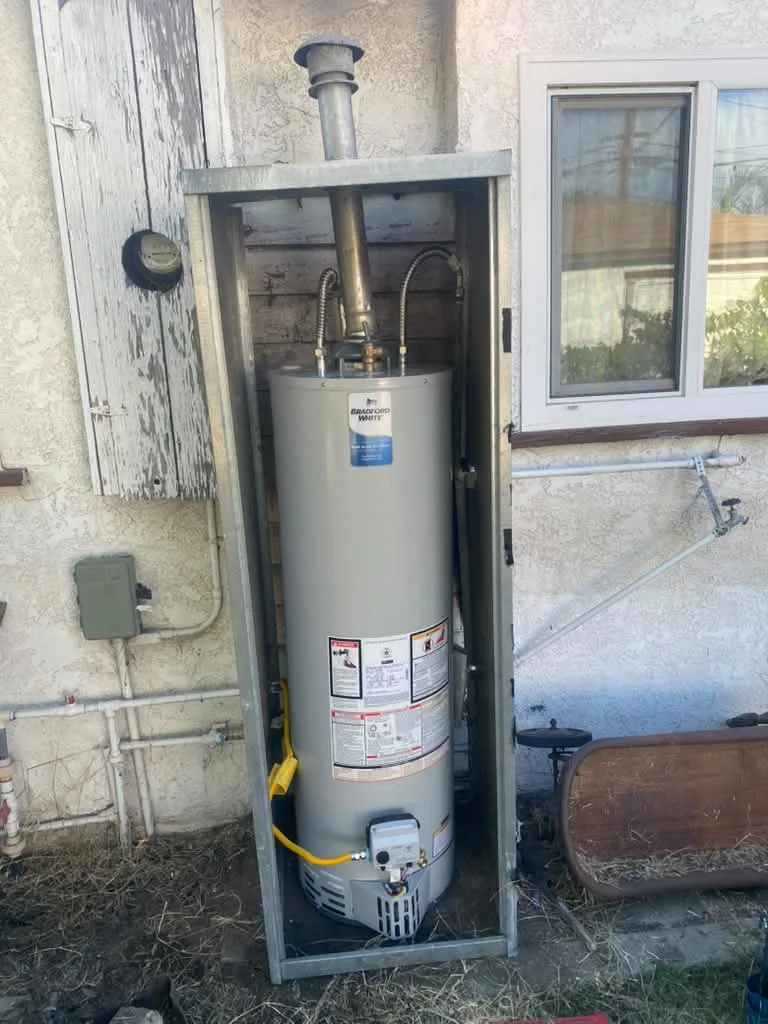
Outdoors, the enclosure has to keep sun and rain off the tank and its connections while still letting the burner breathe. We look over the cabinet itself before a new heater goes back into it, because a rusted base or a door that will not latch is easier to sort out with the old tank already gone.
In a garage, a gas heater has to sit up off the floor where code calls for it, out of the path of a car, and strapped to the wall.
More finished installs are in our job photos, and the general rundown on water heater installation covers the rest of our service area.
Shut off and drain
Gas, water and power to the old unit get shut off, and the tank is drained so it can be carried out safely.
Set the new heater
Level, strapped and turned so the drain valve and the gas shutoff are easy to get at later.
Connect and test
Water lines, gas, venting and the relief valve go on, then the tank is filled and every joint is checked.
Light it and watch it
We fire it, make sure the vent is drawing, and wait for the water to come up to temperature before we call it finished.
Haul the old one
The old tank goes on our truck, and the spot gets swept before we pull out of the driveway.
We have been doing this kind of work for Redlands out of our Yucaipa shop for years. If you want to talk sizes before the old one gives out, send us the details and somebody from the family will get back to you.
The rest of what we do in Redlands
- Sewer Line Repair
Backups that keep returning.
- Drain Cleaning
Slow or stopped drains.
- Repiping
Leaks in several rooms.
- Slab Leak Repair
Leaks under the floor.
Everything else we cover in town is on the Redlands page, and the water heater installation page covers this work wherever you are in the valley.
What should you know before the new heater goes in?
Got a question about your own setup? Call the shop and ask.
How often should a tank be flushed in Redlands?
Once a year is what we recommend here. The water carries enough mineral that sediment builds up on the tank floor, and the burner or element has to push its heat through it. A yearly flush keeps that layer thin, and it is something we are happy to show you how to do.
Can I just put in the same size I had?
You can, but the old size was somebody's guess for whoever lived there back then. If you run out of hot water now, a matching tank will run out too. We ask about the people in the house and how they use water, and we size from that.
Why does my old heater rumble and pop?
That noise is usually water trapped under sediment on the tank bottom, boiling up through it as the burner fires. It means the layer has gotten thick. On an older tank it often means the heater is close to the end, and on a newer one a good flush may quiet it down.
Is it a problem to keep the water heater outdoors?
Not when it is set up for it. An outdoor heater belongs in an enclosure that keeps weather and sun off the tank and the connections, with the venting and gas line arranged for that spot. We check the enclosure itself before reusing it for the new unit.
Will the new heater need different venting or gas piping?
Sometimes. A new tank can call for a different vent size or connection than the one coming out, and code requirements have changed over the years. We look at the vent, the gas supply and the shutoff before the old unit is drained, so nothing catches anyone off guard on install day.
Do I need to get rid of the old heater myself?
No. The crew drains it, disconnects it and takes it away once the new one is running. You will not be stuck arranging a dump run or finding someone to haul a heavy, rusty tank out of the side yard. It is part of the job.
Hot water back on, old tank gone
Tell us what your heater is doing now, who lives in the house and where the tank sits, and we will tell you what the replacement needs. Same-day service is normal, and the quote is free and comes before any work starts.