
When a Redlands house has leaks in more than one place
The water serving Redlands leaves mineral deposits in every pipe it runs through, and given enough years that wears supply piping down from the inside. One leak gets fixed and that is the end of it. Leaks turning up in different rooms are a pattern, and a planned repipe usually beats chasing them one wall at a time.
What the water around here does to a pipe
The supply in this part of the valley carries a lot of minerals, and they come out of the water and settle wherever it flows. You can see it on a showerhead and around a faucet aerator. Inside the walls you cannot, but the same thing is going on, a little more crust every year on lines that sit under pressure day and night.
Copper also wears from the inside where the water turns a corner or moves fast, and that wear tends to show up as pinholes, tiny leaks that spray or weep out of a pipe that looks perfectly fine from the outside. A pinhole behind drywall can go a long while before the wall gives it away, and by then the water has been into the insulation and the framing.
Older galvanized steel has its own version. The inside rusts and narrows until a shower that used to be strong is weak, and the first water out of a tap in the morning comes out tinted.
None of that is anybody’s fault. It is what mineral-heavy water and time do to supply piping, and we see the same story in house after house around here. The good news is that it rarely sneaks up on anybody who knows what the early signs look like.
The crust you wipe off a showerhead is building inside the pipes too.
A single leak gets repaired. Leaks in three rooms are a pattern.
A single leak at a fitting, from a nail that went through a line or a joint that was never quite right, is a repair. We fix it and leave the rest of the house alone, and nobody is going to talk you into a repipe over one bad joint.
The picture changes when the leaks start coming from different places. A pinhole in the kitchen wall in the spring, another one at the laundry, then a damp ceiling under the upstairs bathroom. That is the same pipe giving out wherever it is weakest, and the next one is usually already on its way.
So when you call, give us the whole history, every leak you remember and roughly where it was, even the little one somebody fixed years back. Owners usually remember more of it than they expect to, and that list says more about the piping than any one wall we could open.
Pinhole leaks in more than one room
Green or white crust on exposed fittings
Pressure that drops when two fixtures run
Tinted water at the first draw of the day
A water bill climbing with no change in use
Patching each leak as it shows up means opening a new wall each time, drying out a new room each time, and paying for the same kind of visit again and again on a system that is not getting any younger. A planned repipe does the work once, on a schedule you picked, instead of late on a Sunday with water coming through a ceiling.
How we plan a repipe, room by room
The planning is most of the job. By the time we cut into anything we already know where each new line is headed and which walls have to open to get it there.
Walk the whole house
Every fixture, the water heater, the main shutoff, and where the old lines actually run, whether that is the attic, a crawl space or the slab.
Map the new route
New lines go the shortest sensible way to each room, with access points picked so the cuts stay small.
Open only what the route needs
Each cut is kept as small as the work allows and placed where it will patch cleanly, with the area cleared before it happens.
Run, connect and test
New piping goes in, ties into each fixture and the heater, and the system is pressure tested before any wall gets closed.
Patch and turn the water on
Openings get patched, and where the job allows, the house has water back at the end of each work day.
Going without water at home is the part people worry about most, so we plan the order of the work around it. On some houses that lines up every evening and on others the layout makes it harder, and you will know which kind you have before we start instead of finding out halfway through.
Copper in an open wall, before it gets closed up
That photo is one of ours: three new copper risers standing in an open stud bay, waiting for the wall to go back on. It is the stage where a repipe is easiest to check, and we would much rather you take a look then than take it on faith once the drywall is up.
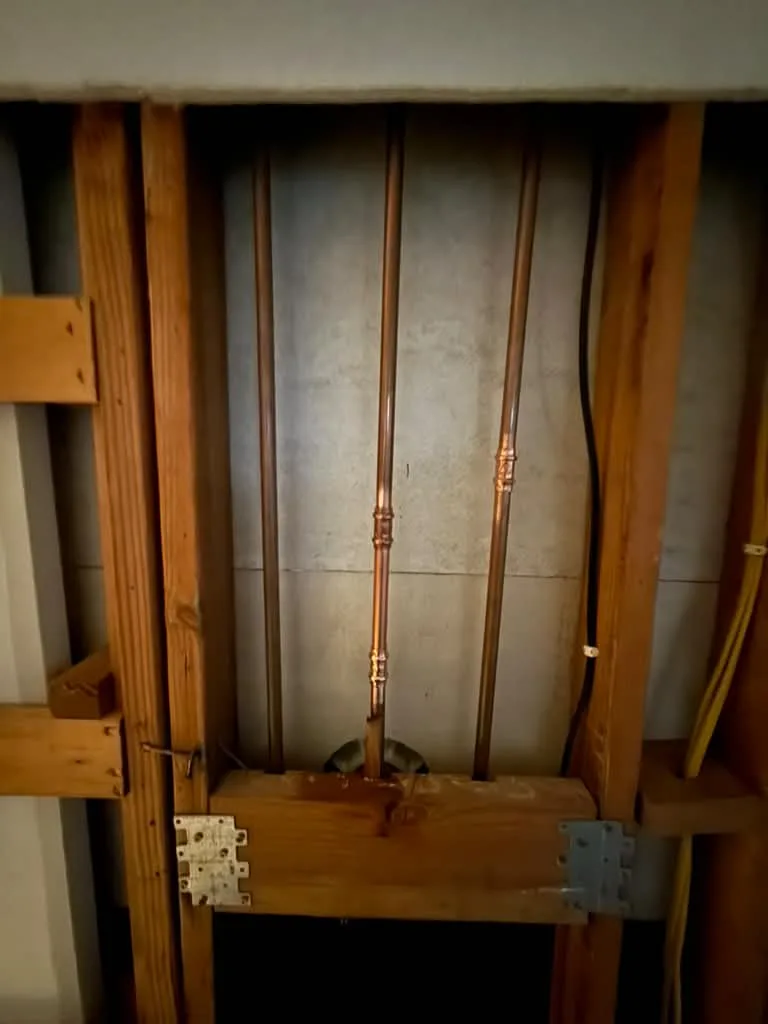
A repipe is a good time to sort out the shutoff valves as well. Old ones that have sat in mineral-heavy water for years like to seize, and a main shutoff that will not turn is about the worst thing to discover in the middle of a leak.
Which material fits your house gets talked through on the walk-through, along with what is already in the walls and how the new lines will tie into the fixtures you are keeping. The number is settled before the first cut.
The family has run this shop out of Yucaipa since 1982, licensed for plumbing, sanitation and general engineering work, and Redlands is a regular stop for us. More finished work is in our gallery, the repiping page explains the work in general, the Redlands page lists the rest of what we do in town, and when you want to talk it over you can get in touch with the shop or just pick up the phone.
The rest of what we do in Redlands
- Sewer Line Repair
Backups that keep returning.
- Drain Cleaning
Slow or stopped drains.
- Slab Leak Repair
Leaks under the floor.
- Water Heater Installation
Leaking or worn-out tanks.
Everything else we cover in town is on the Redlands page, and the repiping page covers this work wherever you are in the valley.
Is it time to repipe, or not yet?
Wondering about your own house? Call and ask, it costs nothing.
How do I know if I need a repipe or just a repair?
Count the leaks and notice where they are. One leak with a clear cause is a repair. Leaks turning up in different rooms, crusted fittings and falling pressure point to the pipe itself wearing out, and that is when a repipe usually makes more sense than continuing to patch.
Will I have water while you work?
Where the job allows, the water goes back on at the end of each work day. Some houses make that harder than others, and you will know which kind yours is before we start, so you can plan around any stretch without it.
How many walls will you have to open?
As few as the route allows, and each opening only as big as the work needs. The route is planned before anything gets cut, so openings land where they patch cleanly and nobody is punching exploratory holes looking for pipe.
Can you repipe just part of the house?
Sometimes. If one branch is failing and the rest of the piping is in good shape, replacing that branch can make sense. If the wear is everywhere, a partial job tends to move the leaks over to the parts you did not replace.
Does the hard water here really make that much difference?
Around Redlands it does. The minerals that crust up a showerhead are building inside the pipes too, and the water heater, fixtures and valves all deal with them. It is also why flushing the water heater once a year pays off more in this area than in most.
Is a repipe worth doing before selling a house?
If the house already has a leak history, it often is, because inspectors look for exactly that. At the least, knowing the condition of the supply piping before you list means fewer surprises during the sale. Call and we will tell you straight what we find.
Tell us how many leaks you have had
Call the shop or drop us a note with how many leaks you have had and where they showed up. That history tells us most of what we need to know, and you will have a plan and a price before any wall gets opened.