Redlands sewer lines, repaired from what the camera shows
A lot of the older houses in Redlands still drain through cast iron, and cast iron gets rough inside, cracks with age and lets roots in at the joints. We run a camera down the line first, you watch the footage with us, and the repair gets picked from what is actually down there.
What cast iron does after enough years
Cast iron was the standard for a long time and plenty of it went in right. It just does not stay smooth on the inside forever, and the older the house, the more likely that is the pipe under the yard.
Scale builds up on the inside wall of an old cast-iron lateral until the pipe is carrying a lot less than it was made to carry, and that rough crust catches paper and grease that would have slid right past when the pipe was new. Cracks open along the bottom where the water runs all day. Every joint is a seam, and roots go looking for seams because there is water and air on the other side of them.
None of that happens in a week, which is why the first signs are easy to wave off. A toilet that needs a second flush. A tub that drains fine on Monday and slow by Thursday. Then one morning the lowest drain in the house backs up and suddenly everybody is paying attention to the sewer line.
The lowest drain in the house backs up first
A toilet gurgles when the washer empties
A sewer smell out by the cleanout
Roots back again after the line was cleared
Several fixtures slowing down together
A soggy strip of lawn over the line
If two or three of those sound like your house, call the shop and tell us which ones, because it helps us bring the right gear the first time out. You can also send us a note about it and somebody will get back to you.
When the dirt shifts, the joints go with it
Ground movement is part of living in this valley, and buried pipe does not get a vote. A lateral can sit straight for years and then one section settles a little lower than the next, so the joint between them opens into a lip. Waste catches on that lip, water pools behind it, and roots find the gap.
An offset like that will not show up on your water bill or as a damp spot in the yard. It shows up as a drain that keeps clogging, often at about the same distance from the house each time, and that repeating distance is one of the first things we look for once the camera is in.
A good share of what we get called to in Redlands is a line somebody already cleared once or twice. Clearing it was not wrong, it just never touched the reason it keeps happening, which is the joint. We are happy to pick up a job another outfit started, and nobody is going to make you feel bad for calling a second shop.
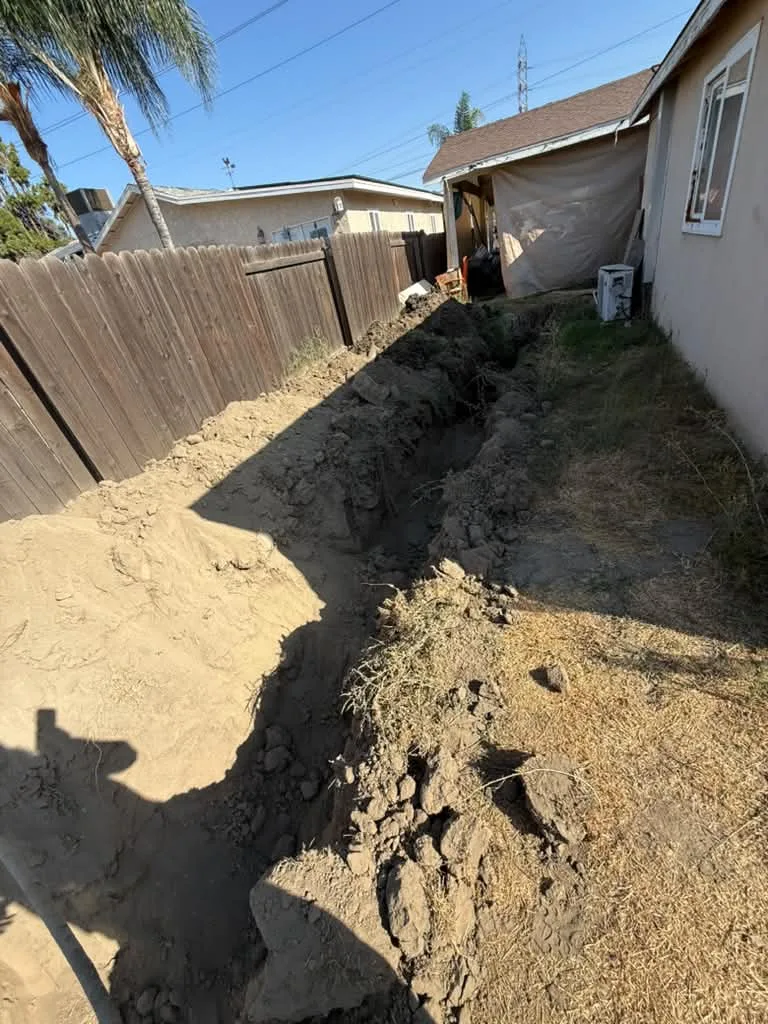
Some runs need a long trench like that one and some only need a hole big enough to work in, and the camera tells us which before anybody picks up a shovel. There are more jobs like it in our gallery of past work.
You watch the footage before anybody digs
The camera goes in at the cleanout and travels the lateral toward the main while the picture comes up on a screen in front of both of us. Roots hanging at a joint look like roots. Scale looks like a rough crust closing the pipe down. A belly looks like a stretch of standing water that should have drained away, and an offset looks like a ledge the camera has to climb over.
We do it that way because the pipe is buried in your yard and you have no other way to check us. Nobody should have to take a contractor’s word for something they cannot see, so we point things out as they come up on the screen and we document what the camera finds, which puts the condition of the line on record instead of in somebody’s memory.
Sometimes the footage is good news. A line that looked awful from the backup can turn out to have one clump of roots at one joint and a lot of sound pipe on either side of it, and that is a much smaller job than the one you were bracing for when you called.
Sometimes it is not good news, and you will hear that just as plainly. Big Mike started this shop in 1982 and the family still runs it the way he did, which means telling people the truth about their line even on the days the truth is the bigger job.
You see what we see, on the screen, before a shovel comes out.
A spot repair, a section, or the whole line
Once the camera has run the full length, the choice usually makes itself. One bad joint in an otherwise sound line gets a spot repair, dug and fixed right where the trouble sits. A few bad joints close together, or a stretch that has settled into a belly, gets that section cut out and replaced, tied back into good pipe on both ends.
When the footage shows scale, cracks and roots all along the run, patching one place just moves the next backup a few feet further down the yard. At that point we will say so and talk with you about replacing the sewer line instead, with the footage right there so you can decide for yourself. If the line has more life in it than you feared, we say that too.
Whichever one it turns out to be, the price is in your hands before work starts, and it comes from what the camera showed us on your property instead of a guess built around the worst thing that could be down there.
We hold plumbing, sanitation and general engineering licensing, so one crew can take the line from the cleanout at the house all the way out to where it meets the main. Our sewer line repair page covers this work anywhere in the valley, everything else we handle around town is on our Redlands page, and whenever you are ready you can tell us what the line is doing.
The rest of what we do in Redlands
- Drain Cleaning
Slow or stopped drains.
- Repiping
Leaks in several rooms.
- Slab Leak Repair
Leaks under the floor.
- Water Heater Installation
Leaking or worn-out tanks.
Everything else we cover in town is on the Redlands page, and the sewer line repair page covers this work wherever you are in the valley.
What do Redlands owners ask about their sewer lines?
Something else about your lateral? Ask us when you call.
Is an old cast-iron line always a problem?
No. Plenty of cast-iron laterals around Redlands still carry everything they need to. Age makes trouble more likely without guaranteeing it, and running a camera through is how you find out which kind of line you have before deciding anything about a repair.
Why did my line work for years and then start backing up?
Usually because something changed slowly underground. Scale built up a little each year, a root found its way into a joint, or the soil settled and pulled a joint out of line. The pipe kept working until the narrowing finally caught enough to stop the flow.
Can I watch the camera inspection?
Please do. We would much rather you stand there and see the screen with us than hear about it afterward. Whatever turns up gets pointed out as it comes into view, and the repair we suggest comes from that footage and nothing else.
Will the yard get torn up?
Only as much as the repair needs. The fault gets located and marked before any digging, so the opening goes right over the problem instead of chasing it around the yard. A single bad joint needs far less ground opened than a long stretch of replaced pipe.
Do roots come back after a repair?
Roots get in through openings, so a joint that has been properly repaired gives them nothing to grow into. Cutting roots out of a cracked joint without fixing the joint is another story, because the gap is still there and so is the water drawing them in.
What if the house is on septic instead of sewer?
Then it is still our work. We hold sanitation licensing alongside plumbing, so the line leaving the house, the tank and the leach field are all handled by one contractor. Tell us which one you have when you call, because it changes what we bring.
Tell us which drain backs up first
Call the shop or send a note and tell us which drain backs up first and how often it happens. That one detail says a lot about the line before we pull up, and the camera does the rest.