Find out what your Highland pipes are before anybody repipes
Most people have no idea what their water pipes are made of, and there is no reason they should. A flashlight and a fridge magnet are enough to find out, and the answer goes a long way toward deciding whether you need a repair or a copper repipe for the whole house.
Where your supply pipe shows itself
Most of it hides in walls and under the slab, but it comes out into the open in a handful of predictable places, and you can check all of them yourself.
Start at the water heater, because the pipes going into and out of the top are nearly always exposed. Then open the cabinet under the kitchen sink and look at the line where it comes out of the wall behind the shutoff valves. Last, walk outside to a hose bib and look at the short stub of pipe it is threaded onto. Between those three you will usually see what the house is plumbed with, and sometimes you will see two different materials, which tells its own story.
Copper colored like an old penny, with smooth soldered joints: that is copper
Dull gray steel with threads showing at the fittings: galvanized
A fridge magnet grabs the pipe and holds on: galvanized steel
A gray pipe the magnet ignores: probably plastic, worth a closer look
Copper at the heater and gray steel at the hose bib: partly redone
If a pipe is too dirty to read, scratch a hidden spot gently with a key. Copper shows bright and pinkish underneath, and galvanized shows a dull silver. Take a look at the main where it comes into the house near the shutoff too, since that is often the oldest pipe on the property. Still not sure? Snap a picture and send it to the shop and we will tell you what you are looking at.
Why galvanized closes up from the inside
Galvanized pipe is steel with a zinc coating, and for a long stretch it was the ordinary supply pipe in houses. The zinc wears through eventually, the steel underneath starts to rust, and rust and mineral scale build inward from the walls. The outside looks about the same the whole time. It is the inside that narrows, a little every year, until a half-inch pipe is moving water through an opening a fraction of that size.
That is why galvanized houses complain about pressure long before they complain about leaks. The shower goes weak when somebody runs the kitchen tap, the washer takes longer to fill, and water that sat overnight comes out tinted brown for a few seconds. Cleaning a faucet aerator helps for a little while, then the flakes come back, because they are coming loose from the pipe and the faucet is only where they land.
Threaded joints are the other weak spot. Every place two pieces of galvanized screw together, cutting the threads left the pipe wall thinner, and that is usually where rust breaks through first. Inland Empire water is hard, so it lays its own mineral scale over the rust and speeds the whole thing along.
A pressure gauge tells part of the story. We put one on a hose bib, note the reading with everything closed, then open a few fixtures inside and watch how far it falls. A strong number at rest and a trickle at the far bathroom once water is moving points at the pipe in between, and that is usually the point where a galvanized house starts to make sense for copper.
The inside narrows a little every year.
What goes in when the old pipe comes out
When we repipe in copper, the old lines come out of service and a new copper system runs from the main to each fixture, sized for the fixtures the house has now. Copper does not rust the way steel does. Its joints are soldered or pressed instead of threaded, so there is no thinned-out thread for corrosion to start on, and the smooth bore gives scale less to grab.
At the water heater, the short threaded steel nipples on top are often the first thing to rust through, and swapping them for copper with a proper transition fitting is a small job we do on its own when the rest of the plumbing is still sound.
Copper is not the only supply pipe out there, and we will not pretend it is. Plastic lines have their place, and some houses are better served by them. Water quality around Highland shapes what we recommend more than people expect, along with how the existing lines are laid out and what the walls are made of. If copper is right for your house we will say so, and if something else fits better you will hear that instead.
The new lines are pressure tested before any wall gets closed, so a bad joint shows itself while it is still easy to reach.
The hose bibs in the side yard count too
A repipe that stops at the outside wall leaves some of the oldest pipe on the lot in the ground. The lines feeding hose bibs along the side and back of a house are often original, and on the bigger lots around Highland they can run a good distance. When those get replaced, the new copper goes into a shallow trench along the foundation, comes up the wall to each bib, and the dirt goes back over it.
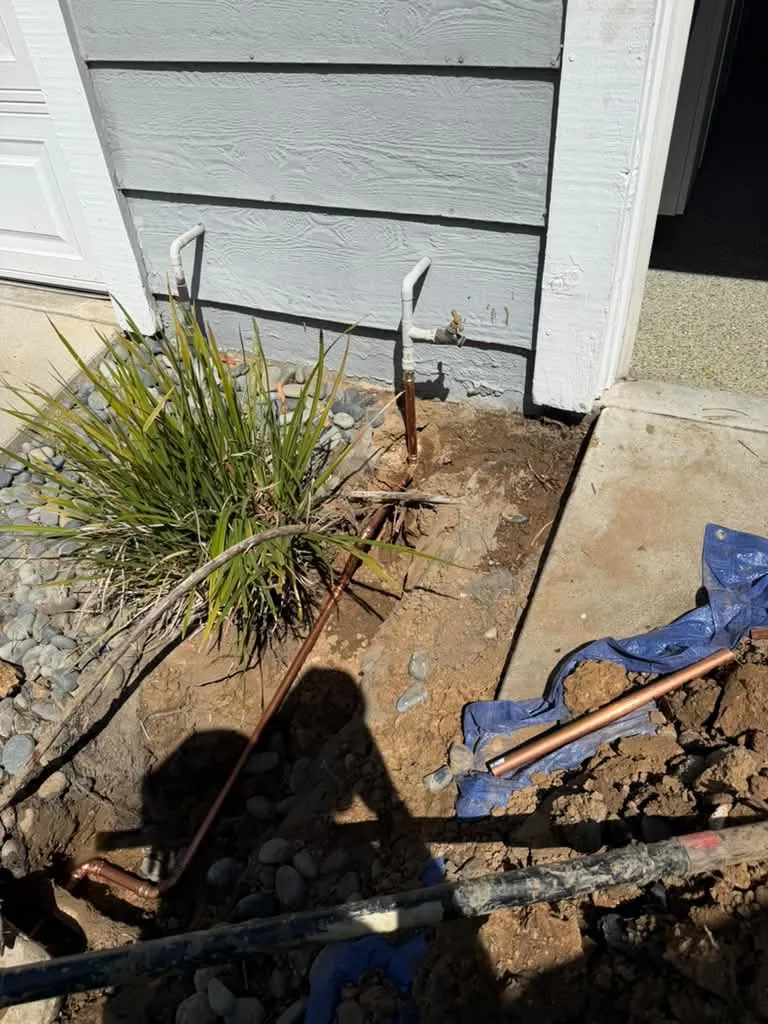
Where it comes up the wall, the line gets a sleeve or clearance so it is not rubbing on stucco or concrete, which is the kind of spot that wears through where nobody looks.
Inside, the work is planned around opening as little wall as we can. We work out where each new line has to travel before anything is cut, then open the wall only where a pipe has to pass, often inside closets, under cabinets or behind fixtures where a patch disappears. Those openings get patched once the new lines have been tested, and we show you before we start where they will be, so nothing gets cut that you were not expecting.
We hold plumbing, sanitation and general engineering licensing, so one shop can take new copper from the main valve, through the yard and into the house without handing any of it off. The family that runs the shop now learned the trade from Big Mike, who opened it in 1982. You can look through photos of our work in the gallery, read the full rundown on our copper repiping page, or see what else we handle nearby on the Highland page.
The rest of what we do in Highland
- Sewer Line Replacement
Laterals past patching.
- Leak Repair
Drips, stains and wet drywall.
- Bathroom Plumbing
Toilets, showers and old cast iron.
- Emergency Plumbing
Trouble that cannot wait.
Everything else we cover in town is on the Highland page, and the copper repiping page covers this work wherever you are in the valley.
What do people ask about their pipes before a repipe?
Want to know what your pipes are made of? We can tell you on a visit.
Can a house have copper and galvanized at the same time?
Yes, and plenty of houses do. Somebody replaced the lines near the water heater or a bathroom at some point and left the rest. Where copper is joined straight to steel, the joint can corrode faster, so we look closely at those transition fittings when we come out.
Does the magnet test work on painted pipe?
Usually, yes, because a magnet will still grab steel through a coat of paint. Copper and plastic will not hold a magnet at all. If the pipe is painted and the magnet slides off, scratch a hidden spot and look at the color underneath.
Is low water pressure always the pipe?
Not always. A failed pressure regulator, a valve left partly closed or a clogged fixture can all cause it. When the whole house is weak and the pipes are galvanized, though, the inside of the pipe is the usual suspect, and a gauge reading helps narrow it down.
Do you replace the outside lines too?
We can, and we usually bring it up. The pipe feeding hose bibs is often among the oldest on the property, so a repipe that skips it leaves an old weak spot in the system. We look at those runs on the first visit and you decide whether they go in the plan.
Will you have to open every wall?
No. Openings go only where a new line has to pass, and we pick spots that are easy to patch and out of sight whenever we can. The walls get patched once the new piping has been tested and is holding pressure.
Do I need a repipe or just a repair?
One failed fitting on otherwise sound pipe is a repair. Galvanized that is scaled shut and dropping pressure across the house is different, because fixing one section does nothing for the rest of it. We tell you which one you are looking at and you choose.
Not sure what is in your walls? Ask the shop.
Tell us what you found at the water heater and the hose bib, or send a picture, and we will tell you what kind of pipe you have and whether it needs anything at all. If it does, you get the plan and the number before anyone opens a wall.