
That Highland water bill might be pointing at a leak
A lot of the leaks we chase in Highland start with a water bill that jumped for no reason, or a stain spreading across drywall. Either way the water has usually been at it for a while. We track down where it is actually coming from, open the wall at that one spot and fix the pipe without tearing out a room to find it.
The stain is rarely sitting right under the leak
Water finds the easiest path, and inside a wall that path usually runs along the framing.
Our Highland page has the rest of what we handle around town, from water heaters to septic.
A pinhole in a supply line drips onto a stud or a ceiling joist, and from there it follows the wood sideways or downhill until it finds a spot to soak through. So the brown ring on the hallway ceiling can belong to a pipe several feet away, and opening the drywall right under the stain often just shows you wet framing and no pipe at all. That is how one leak turns into a row of holes in a wall when somebody guesses.
It is the main reason our leak repair work starts with finding the pipe before touching a wall.
Things worth telling us when you call, because each one narrows the search:
Where the stain is and whether it is growing
Whether it shows up all the time or only after a shower
A water bill higher than your usage explains
Warm spots on the floor or a hissing sound with everything off
Whether the meter moves with every tap closed
Each one on its own is a clue; together they point us at which pipe to go looking for, and that saves time on the visit.
A pressurized pipe leaks around the clock
The supply lines in a house are under pressure every minute of the day, whether anybody is using water or not. A hole in one of them leaks constantly, which is why it shows up on the water bill and why the stain keeps growing even while you are at work.
Drain lines are different. They only carry water when a fixture empties, so a cracked drain fitting stays dry most of the day and only weeps when somebody showers, runs the dishwasher or flushes upstairs. Those leaks can go a long time without showing up on the bill at all, and they tend to announce themselves as a smell or a stain that comes and goes.
You can check which one you have before you call. Turn off every tap and appliance in the house, then go look at the water meter. If the dial or the little leak indicator is still moving, something on the pressure side is leaking. If it sits perfectly still and the stain still grows after showers, the drain side is the better bet.
Slab houses add a wrinkle. A pressurized line that fails under the concrete can show up as a warm spot on the floor, and finding it before any concrete gets broken is the whole point of locating it carefully.
Not every leak is in a wall. The hoses behind the washer, the connection under the dishwasher and the thin line feeding a refrigerator ice maker all sit where nobody looks, and they are common places for water to run unnoticed for a long time.
Worth checkingHigh pressure quietly shortens everything on the line
Some leaks have a cause sitting upstream of them. When the water coming into a house runs at high pressure, every valve, supply hose, faucet cartridge and appliance connection takes a little more strain each time it opens and closes, and the weak spots give out sooner than they should.
You can check it yourself with a pressure gauge on a hose bib. Anything above about eighty psi is too much for a house, and a pressure regulator on the main line is an inexpensive part that protects every fixture past it. If yours already has one and the reading is still high, the regulator itself may have worn out.
Most calls end with one fixed pipe, and that is all there is to it. When leaks keep turning up in different parts of the house, the pipe itself is usually wearing out, and chasing each one as it appears adds up quickly. That is the point where repiping is worth talking about, and we will be straight with you about whether you are there yet.
After forty-four years working this valley, there is a good chance we have chased the same kind of leak in a house on your street, and the family running the shop now learned the trade from the man who started it.
Call the shop if you have a stain, a high bill or a sound you cannot place, and tell us what you have noticed. If writing it down is easier, the contact page works too, and the more detail you give us the shorter the hunt.
Find the leak first, and the hole in your wall stays small.
Find it first, then open one small hole
Guessing is what wrecks bathrooms. We would rather spend the time up front pinning the leak down to a spot, and then open the wall exactly there.
Narrow it down
We start with what you told us on the phone and confirm whether the leak is on the supply or the drain side.
Locate the spot
Leak detection with pressure testing, listening gear and thermal imaging takes it from a room down to a spot on the wall.
Open a small access cut
One neat rectangle in the drywall, sized to work through and easy to patch, instead of a long gash across the room.
Repair the pipe
The damaged length comes out and new pipe goes in, joined to the existing line at both ends.
Pressure it back up
We turn the water back on and watch the repair under full pressure before anyone closes the wall back up.
When the pipe is somewhere we can reach, finding it and fixing it usually happen on the same visit, so you are not living with a hole in the wall in between.
This is what one of those cuts looks like on a real job. The opening sits beside the sink counter in a textured bathroom wall, and inside it the new copper with pressed fittings is joined to the older gray fitting that was already there.
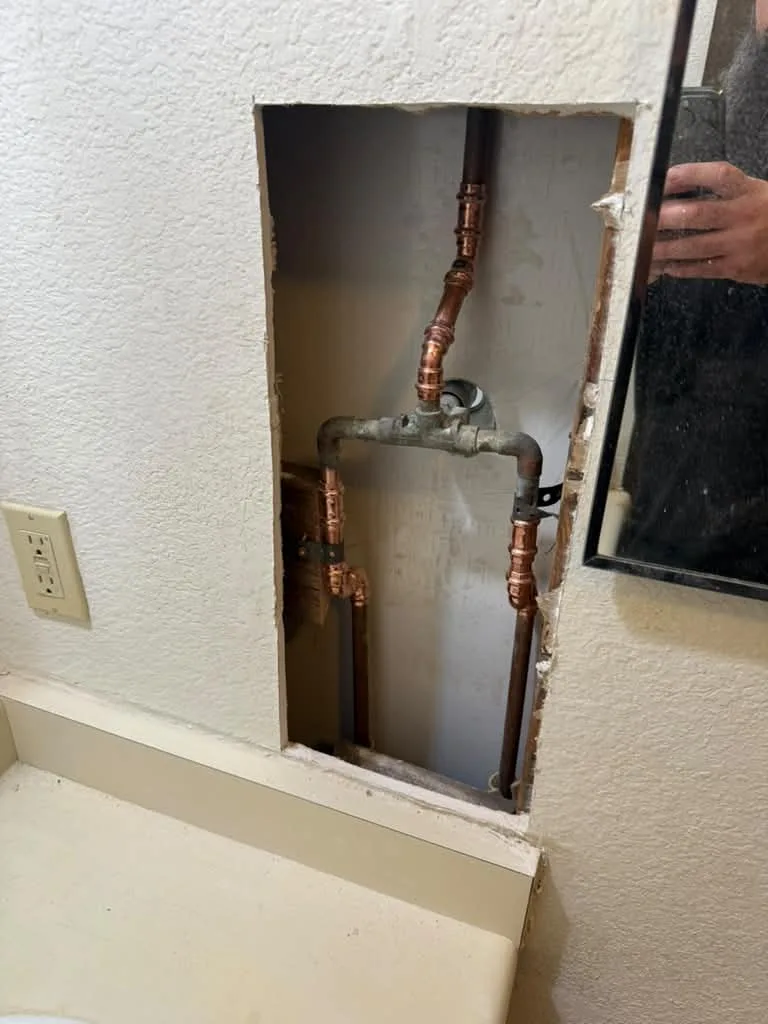
A small opening like that is a quick patch for whoever does your drywall, and the rest of the bathroom never gets touched.
There are more jobs like it in our gallery.
The rest of what we do in Highland
- Sewer Line Replacement
Laterals past patching.
- Bathroom Plumbing
Toilets, showers and old cast iron.
- Emergency Plumbing
Trouble that cannot wait.
- Copper Repiping
New copper for tired supply lines.
Everything else we cover in town is on the Highland page, and the leak repair page covers this work wherever you are in the valley.
Where is my water actually coming from?
Seeing a stain we did not cover here? Describe it on the phone.
Why is there a stain but no wet pipe behind it?
Because water runs along studs and joists before it soaks through, the stain often shows up a few feet from the actual hole. That is why we locate the leak before opening anything, so the cut lands on the pipe itself.
How can I tell if it is a supply leak or a drain leak?
Shut off every faucet and water-using appliance, then check the meter. If it still moves, the leak is on the pressurized side and running all the time. If the meter stays still but the stain spreads after showers or flushes, a drain fitting is the more likely culprit.
Do you have to tear out the whole wall?
No. Once the leak is pinned to a spot we open one small access cut, make the repair through it and test it under pressure. A small rectangle is far easier to patch than a wall opened up across the room on a guess.
What water pressure is too high for a house?
Roughly anything over eighty psi. At that level every fixture, valve and appliance connection wears faster, and leaks show up sooner. A gauge on a hose bib tells you where you stand, and a pressure regulator is a cheap part that takes the strain off everything after it.
When does it make sense to stop fixing leaks and repipe?
A one-off leak is a simple repair. If new leaks keep appearing in different spots around the house, the piping itself is wearing out, and we will tell you honestly whether repiping costs less than continuing to chase them one at a time.
What should I do while I wait for you?
If water is actively coming through, shut off the main or the valve feeding that fixture, and turn off power to anything electrical near the wet area. Move what you can out of the way, take a few photos of the stain, and jot down when it seems to get worse.
Seeing water where it should not be?
Call the shop and walk us through what you are seeing, where the stain is and whether the meter moves with everything off. We will come find the leak, show you where it is before we open anything and tell you what the repair involves.