
A Highland sewer line that has run out of patches
Bigger lots in Highland mean longer sewer laterals, and every extra length of pipe brings more joints that can open up, sag or let roots in. Once the same line keeps failing in new spots, patching it again is money spent on a pipe that is finished. Nobody picks up a shovel until the picture on the screen has made the case for it.
Bigger lots come with longer laterals
Plenty of Highland properties sit on larger lots, and the sewer line has to cross all of that ground before it reaches the main.
The longer the run, the more there is to look at before anyone decides on sewer line replacement.
A lateral is built from lengths of pipe joined end to end, and each joint is a seam. On a short city lot there might be a handful of them between the cleanout and the street. On a bigger lot the count goes up, and so do the chances that one of them has pulled apart, dropped or let a root hair through. More pipe in the ground is more pipe that can go wrong, and that is just math.
These are the signs that a line has gone past the point where one more repair makes sense:
The same section backing up again after a repair
Water sitting in a low belly along a long run
Cast iron scaled down to half its old opening
Roots coming in at one joint after another
Sewage smell or soggy ground over the line
Any one of those on its own might still be a repair. Two or three together on the same line usually means the pipe is telling you it is done.
Highland is part of our regular territory, so a long lateral on a big lot here is familiar ground for us. There is more about the area on our Highland service page.
A look down the line comes first
Every replacement we do starts at the cleanout with a camera on a push cable. It runs the whole length of the lateral and records what it passes, so the decision gets made from pictures of your own pipe.
We want you standing there for it if you can be. You will see the belly where water sits, the joint with roots pouring in, the spot where the cast iron has crusted over until there is barely room for anything to get by. Most people have never seen the inside of their own sewer line, and once they have, the conversation about what to do gets a lot shorter.
The camera also tells us where to dig. A locator picks up the camera head from above ground, so we can mark where the line actually runs and how deep it sits before any equipment shows up. On a long lateral that matters, because lines do not always go where the house plans say they go.
A belly is the one people find hardest to picture. Part of the line has settled lower than the pipe on either side of it, so a little water always sits there, and paper and solids drop out and collect in that low spot every time the line runs. Cleaning it out helps for a while, but the dip is still there afterward, so the clog keeps coming back.
Cast iron is the slow one. It builds scale on the inside as it ages, and the opening keeps getting smaller and rougher, until on some old lines the camera shows about half the pipe it started with.
Pictures from some of our digs are in the gallery if you want to see what these jobs look like from the yard.
Replacement day, start to finish
Once the footage says the line is finished and you have said go ahead, the work itself follows the same order on just about every job.
Mark the run
We trace the old line from the house to where it meets the main and mark it on the ground, along with anything else buried in the way.
Open the trench
A mini excavator cuts the trench along the marked path, with the dirt piled to one side so it can go back in the same hole.
Pull the old pipe
The failed pipe comes out in pieces, and you are welcome to look at it. Seeing the scale and root mass in your hand settles any doubt.
Bed and set the new line
New pipe goes down on bedding so it is supported along its whole length, and it is set with a steady fall toward the main so waste keeps moving.
Put the yard back
The trench gets backfilled and compacted, the old pipe leaves with us, and the ground is left level so you are not stepping into a dip next month.
Here is one of ours partway through, with the trench open across the yard and the mini excavator still working at the head of the cut.
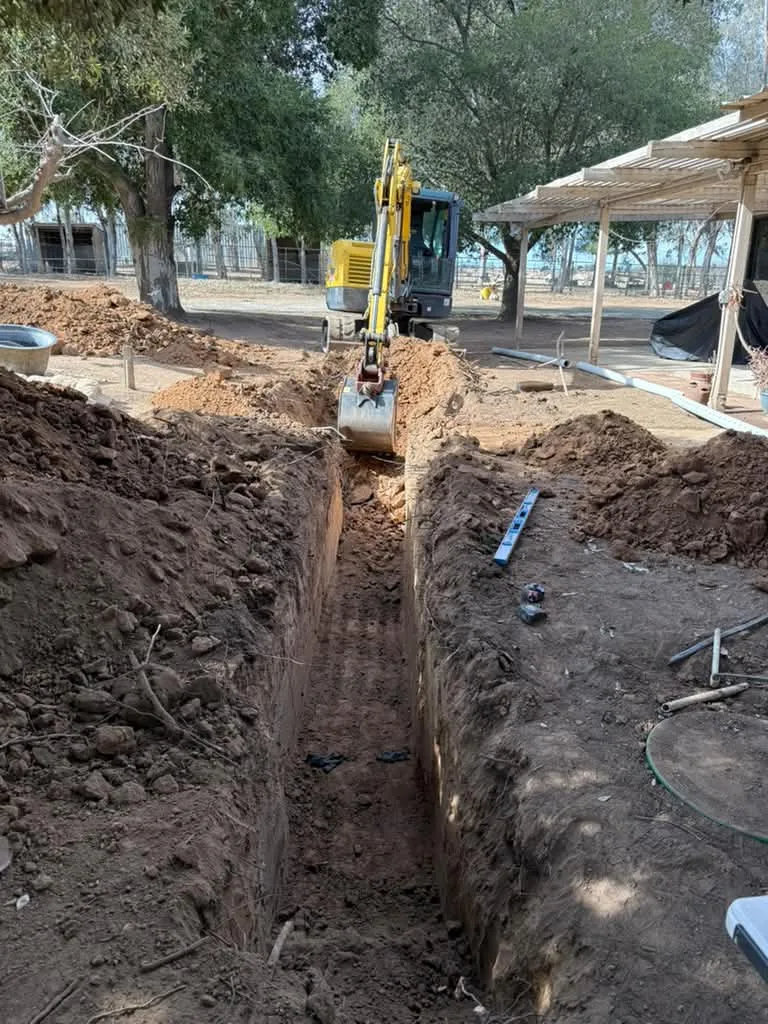
We keep the dig to the line. Patios, walkways and trees get worked around where the run allows it, and when something has to come out to reach the pipe we tell you before it happens.
Most of the time the old pipe and the new one follow the same path, because that is where the connection at the house and the connection at the main already are.
Sometimes the honest answer is one section
Replacing a whole lateral is a big job and nobody should talk you into it when the line does not need it. If the camera shows one cracked joint or one offset section in a pipe that is otherwise in decent shape, the right move is to fix that piece and leave the rest alone. That is a sewer line repair, and we would rather do that for you than sell you a trench you did not need.
Big Mike started this shop in 1982, the family runs it now, and the way customers get treated is the part he cared most about handing down. Part of that is telling you plainly what your line needs. You get the footage, what we think it means and what happens if you wait, and then you decide.
Because we carry plumbing, sanitation and general engineering licensing, the digging, the pipe and the connection at the main are all one contractor’s job. You are not lining up an excavation outfit and a plumber and hoping they show up the same week.
If the drains have been acting up, the contact page is the quickest way to get the details to us, or just pick up the phone.
If one bad joint is the whole problem, you will hear that from us first.
The rest of what we do in Highland
- Leak Repair
Drips, stains and wet drywall.
- Bathroom Plumbing
Toilets, showers and old cast iron.
- Emergency Plumbing
Trouble that cannot wait.
- Copper Repiping
New copper for tired supply lines.
Everything else we cover in town is on the Highland page, and the sewer line replacement page covers this work wherever you are in the valley.
Is my sewer line really due for replacing?
Not sure yours needs the whole line? That is a fair thing to ask us.
How do I know replacing is the right call instead of a repair?
The camera decides it. One cracked joint or one dropped section in a line that is otherwise sound gets repaired. When the footage shows trouble spread along the run, or the same spot has failed more than once, replacing the line is usually the cheaper path in the long run.
What does the footage need to show before you replace the line?
Trouble in more than one place along the run. Roots coming in at joint after joint, a long sag that keeps water standing, cast iron scaled down to a fraction of its opening, or a fresh break near a spot that was already fixed. One bad spot in an otherwise sound pipe gets a repair instead, and we will tell you so.
Can you work around my patio and trees?
Usually. The run gets marked before any digging, so you can see where the trench will go. Where the line passes under a patio or close to a tree, we go over the choices with you first, like cutting a narrow strip of concrete or digging by hand near the roots, and the ground is backfilled and leveled before we leave.
Why do longer sewer lines seem to fail more?
A longer lateral is made of more lengths of pipe, which means more joints, and every joint is a place where roots can get in or ground movement can pull things out of line. Larger Highland lots tend to have longer runs, so there is simply more to go wrong.
Do you handle the digging yourselves?
Yes. We hold plumbing, sanitation and general engineering contractor licensing, so the excavation, the new pipe and the tie-in are all done by our crew. You deal with one shop from the first camera run to the last load of dirt going back in the trench.
Do you charge for the quote?
No. Quotes are free, and on a sewer line ours comes after we have actually looked at the problem, since a replacement number given over the phone from a description would only be a guess. You will know what the job costs before any digging starts.
Got a line that keeps backing up?
Tell us how long the drains have been slow and which ones back up first. We will run a camera down the line, sit you in front of the footage and tell you straight whether you are looking at a repair or a whole new lateral.