Repiping a Loma Linda building while people keep using it
A commercial building rarely gets to close for a repipe. Offices stay open and apartment tenants still need a shower in the morning. So we plan the work in sections, shut the water off in short windows everybody hears about ahead of time, and leave each area clean and usable at the end of every day, until the whole building is on new pipe.
How a building tells you its pipe is done
One leak in one suite is a repair. The pattern that points at the whole system looks different, and owners and property managers usually spot it in the call log before anyone spots it in the pipe.
Leaks showing up in different suites or units, months apart, with no common cause
Rust-colored water at the first draw of the morning, or after the water has been off
Fixtures on the upper floor losing pressure while the ground floor seems fine
Clamps and patches piling up on the same runs every time a ceiling gets opened
Shutoff valves that will not close all the way when a section needs isolating
Any one of those can have a smaller explanation, and we look for it before anybody says the word repipe. When several of them show up together, the supply piping is usually wearing out from the inside, and fixing the leaks one at a time turns into a standing appointment with a plumber and a ceiling crew.
A building full of tenants also carries a cost the repair bill never shows. Every leak above a suite means an office closed for an afternoon, a ruined ceiling tile, maybe a computer sitting under a drip, and a phone call the property manager would much rather not have to make.
The rest of the town’s plumbing, homes included, is covered on our Loma Linda service area page.
The schedule gets planned before the pipe does
For a business, a day with the water off costs more than the repair itself. That one fact shapes the whole job.
Our commercial repiping page covers this work in general terms.
Before anything gets cut we walk the building with whoever runs it, find every shutoff that actually works, and split the system into sections that can be isolated on their own. Each section becomes its own small job with its own short shutdown, and the rest of the building keeps its water while we are working.
Map the building
We trace the risers and the branch runs and note which suites, units or restrooms each one feeds.
Set the windows
Shutdowns get scheduled around tenants and operating hours, early mornings, evenings or weekends where that keeps a business open.
Announce them
Tenants hear when their water goes off and when it comes back on, ahead of time, so nobody finds out at the sink.
Run the new line alongside
Where there is room, the new pipe goes in next to the old, so the tie-in is the only stretch with the water off.
Switch over and test
The section is connected, pressurized and checked before the old pipe comes out or the ceiling goes back up.
Apartment complexes get the same treatment as offices, only planned with mornings in mind, because a tenant can manage without a break room sink for an hour and cannot manage without a shower before work.
Up above the dropped ceiling, where the supply lines run
In most commercial buildings the supply piping is not buried in the walls the way it is in a house. It runs overhead, above the grid of ceiling tiles, sharing the space with ductwork, data cable and whatever every contractor before us left up there. That is good news for a repipe. Tiles lift out, the work happens overhead, and the tiles drop back in without anybody patching drywall.
It does mean working carefully around everything else in that space. Cable bundles and insulated lines get left alone, and new pipe is hung on its own supports so it is not leaning on somebody else’s system.
At the end of each day the area below gets put back the way people need it: tiles in place or the opening closed off, floors clear, drop cloths picked up, the restroom or break room working again. Tenants should be able to walk in the next morning and get to work without stepping around our tools.
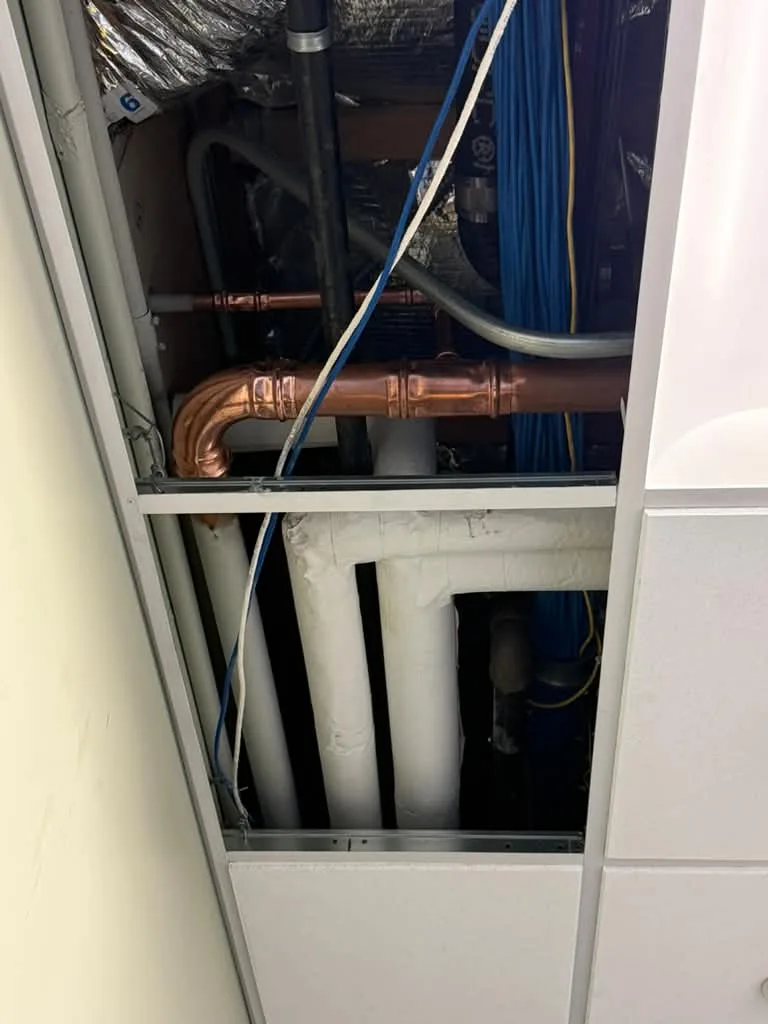
Pipe hung overhead on its own supports stays where we put it, and nobody has to cut a wall to look at it again. Years from now, when someone needs to get at a valve or check a joint, a tile comes out and there it is, with the new copper still running in a straight line past everything else up there.
More of the shop’s commercial and residential jobs are in our gallery.
One callFrom the street side to the last faucet, one shop answers for it
A commercial repipe touches more than supply pipe. The service line coming in, the main shutoff, the pressure on the building, the water heaters, the fixtures at the far end of every run, and now and then a drain that turns out to be part of the trouble. When one contractor handles all of it, nobody is waiting on a second company to show up before a section can go back into service.
We work residential, commercial and industrial property, and the shop carries plumbing, sanitation and general engineering licensing, so the job does not stop at the property line or the edge of the slab. Commercial customers around Loma Linda run anywhere from a single storefront up to an apartment complex, and the same careful planning works at either size.
Big Mike started the company in 1982 and the family runs it now, which matters on a long job, because the people who plan it are the same people who pick up the phone when a tenant has a question halfway through. If your building has started showing the signs, call the shop and tell us what you are seeing, or write it up on the contact page and we will come walk it with you.
The people who plan the job are the people who pick up the phone halfway through it.
More we handle in Loma Linda
- Hydro Jetting
Grease and roots scoured out.
- Plumbing Inspections
A look before buying or renting.
- Grease Trap Cleaning
Interceptors pumped and scraped.
- Office Building Plumbing
Restrooms, risers and tenant suites.
Everything else we cover in town is on the Loma Linda page, and the commercial repiping page covers this work wherever you are in the valley.
What do building owners ask before a repipe?
Managing a building? Ask how a repipe fits around your tenants.
Can you repipe our building while it stays open?
In most cases, yes. We split the system into sections that can be shut off on their own, so only one part of the building is without water at a time, and those shutdowns are kept short and planned around when the building is busiest.
How will our tenants know when the water is going off?
We set the shutdown windows with you in advance, and the tenants are told the day and the hours ahead of time. If a window has to move, they hear about that change as well.
Can the work happen outside business hours?
Yes. When daytime shutdowns would close a business, we schedule the noisy work and the water-off work for early mornings, evenings or weekends. Tell us your operating hours at the start and we plan around them, so the people in the building notice as little of us as possible.
Why do the supply pipes run above our ceiling tiles?
Most commercial buildings route their supply lines overhead, above the dropped ceiling, instead of inside the walls. That makes a repipe far less disruptive, because tiles come out and go back in rather than drywall being cut open and patched in every suite.
When does repiping make more sense than fixing leaks?
When leaks keep turning up in different suites with no single cause, the water comes out rusty, or upper floors are losing pressure, the pipe itself is usually the problem. One isolated leak is a repair. We will tell you plainly which side of that your building is on.
Do you repipe apartment complexes too?
Yes. Apartment complexes, offices, storefronts and other commercial property are all work we do. Apartments get scheduled with mornings in mind, since residents need water before work, and we coordinate access to units with the property manager so nobody is surprised by a knock.
Leaks turning up in more than one suite?
Call the shop and tell us about the building, how many floors it has, where the leaks have shown up and when the place is busiest. We will walk it with you, find the shutoffs and lay out how the work could go in sections around your tenants.