Digging to a buried San Bernardino pipe and putting the ground back
Most of what we dig is a way to reach a pipe. A sewer lateral breaks under a lawn, or a building needs a cleanout where it never had one, and the only road to the problem goes down. The excavation and the plumbing come out of the same shop, so nobody sits around waiting on a second company to open the ground or to close it again.
BeforeNothing gets dug until the ground is marked
Before a shovel goes in, the gas, power, water and communication lines under the work area get located and marked on the surface. We do not skip that step on small jobs, because even a shallow hole can run into a gas line or a buried power feed, and nobody wants to find one that way.
The paint on the ground shows roughly where a utility runs. Inside the marked zone we dig by hand, carefully, until we can see the line itself, and only after that does a machine work close by. Lines a property owner put in, like sprinkler pipe, landscape lighting or a feed out to a sign, are often on nobody’s map, so we ask what has been added over the years and go slow wherever the answer is fuzzy.
The camera usually goes in before the dig as well. Running it down the sewer and finding its head from above shows where the break is and about how deep, so the pit lands on the problem the first time instead of turning into a trench that wanders across the property hunting for it.
Inside the marked zone we dig by hand, carefully, until we can see the line itself, and only after that does a machine work close by.
Deep pits next to planters, curbs and walkways
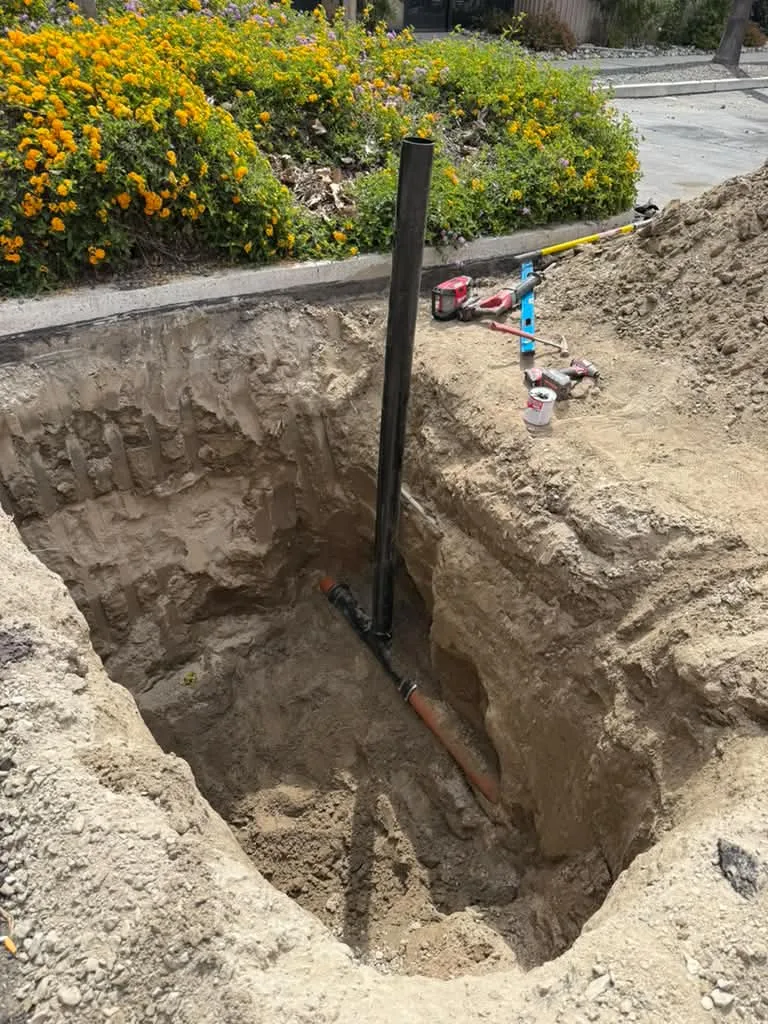
A sewer line can sit a long way down, and a hole deep enough to reach it cannot have dirt walls that a person simply stands between. Depending on the depth and how the soil is holding, the sides get sloped back, stepped or braced before anybody climbs in to work on the pipe. That is the slow part of a dig, and it is the part we will not rush to save an hour.
Homes and businesses alike usually have something worth saving right beside the hole: a planter bed, a curb, a walkway, an irrigation line feeding the shrubs. We decide where the spoil pile goes before we start, lay protection down where the equipment travels, and cut back only as much planting as the pit actually needs. Where a shrub can be dug out and set aside for replanting, we do that instead of cutting it.
Where a dig ends with a new cleanout, the riser comes up inside the bed or beside the curb, wherever it will stay clear of mowers and foot traffic.
More digs and repairs from the trucks are in the gallery, and the full range of digging we take on is laid out on our excavation page.
Closing the hole so the patch does not sink
Most of the trouble with an old dig shows up months later, as a dip in the lawn or a cracked square of asphalt sitting over the trench. That comes from the way the hole was filled.
Everything else we handle around town, from water heaters to septic, is on our San Bernardino service area page.
Shoveling the dirt back in and driving a truck over it leaves air pockets that keep settling long after the crew is gone. A pipe resting on a rock or a chunk of broken concrete can also crack at the spot where that weight presses on it. So the fill goes back in a set order:
Bed the pipe
Clean, fine material goes under and around the new pipe so nothing hard bears against it.
Fill in layers
The rest of the hole gets filled a layer at a time, never all at once.
Compact each layer
Every layer is compacted before the next goes in, which keeps the surface from dropping later.
Restore the top
Soil and plants go back on a lawn or bed, and concrete or asphalt gets patched where we cut it.
Material that should not go back in the hole, like broken concrete, old pipe and big rock, gets hauled away instead of left in a heap by the curb.
On a parking lot or a slab the patch is the part everybody sees for years afterward, so the saw cut is kept square and tight to the pit. A clean edge and a well-compacted base underneath are what keep a patch flat and level with the surface around it once cars start rolling over it again.
One shop for the hole and the pipe inside it
Plenty of plumbing jobs stall because the plumber is waiting on an excavating company, and then the excavator has to come back once the pipe work is done to fill everything in. Each handoff adds days and another set of people to coordinate. We carry the general engineering licensing for the digging side, so the crew that opens the ground is the same crew that fixes the pipe and backfills over it.
On a commercial property that matters even more. A dig across a parking area or beside an entrance has to be planned around customers, deliveries and tenants, and the work can be phased so part of the lot stays usable while the trench is open.
Permits and inspections are handled as part of the job wherever the work calls for them, and the hole stays open for an inspector when one needs to see the pipe before it gets covered. You do not have to figure out who to call or when.
Before anything gets dug, you hear where the hole will go, roughly how big it has to be and what it is going to disturb on the way down. If the camera shows the line can be reached or repaired with less digging than you feared, that is the plan we bring you.
If something on your property has to be dug up to get at a line, send us the details and we will come look at it before anybody puts a number on the job.
More we handle in San Bernardino
- Commercial Water Line Installation
New lines to buildings.
- Commercial Water Line Repair
Breaks under lots.
- Commercial Sewer Repair
Broken laterals at businesses.
- Commercial Drain Cleaning
Kitchens, restrooms, floor drains.
Everything else we cover in town is on the San Bernardino page, and the excavation page covers this work wherever you are in the valley.
Questions people ask before we start digging
Wondering what a dig does to your lot? Ask us before we start.
Do I need to arrange the utility markings myself?
No. We have the underground utilities located before the job starts and we hand dig inside the marked areas. What helps most from you is anything you know about lines you added yourself, like sprinklers, lighting or a feed to a detached building, since those are rarely on any map.
How big will the hole be?
Only as big as it needs to be to reach the pipe and work on it safely. A camera and a locator usually pin down the problem spot first, so we can dig one pit instead of a long trench. Deeper lines need wider holes because the sides have to be sloped or braced.
What happens to the landscaping around the dig?
We plan the dig around it. The spoil pile goes where it does the least harm, plants that can be lifted get set aside, and the bed is put back when the hole is filled. Anything that cannot be saved, we tell you about before we start instead of after.
Will the trench sink after you fill it?
It should not. The pipe is bedded in clean material, and the hole is filled in layers that are each compacted before the next goes in. Settling over old trenches nearly always comes from fill dumped back all at once, and that is the shortcut we do not take.
Can you dig through concrete or asphalt?
Yes. We saw-cut only the area the pit needs, break it out, do the work underneath and patch the surface afterward. On a commercial lot the cut can be staged so part of the parking stays open while the hole is in.
Why have a plumber do the digging instead of an excavating company?
Because the dig only exists for the pipe. When one crew opens the ground, fixes the line and backfills it, there is no gap waiting for a second company and no argument later about who is responsible for what. We hold the licensing to do both halves of that job.
Something buried that needs reaching?
Call the shop and describe what you are seeing up top, whether it is a wet spot, a sinking patch or a drain that will not clear. We find the problem first, then dig only where the pipe actually is and put the ground back the way it belongs.